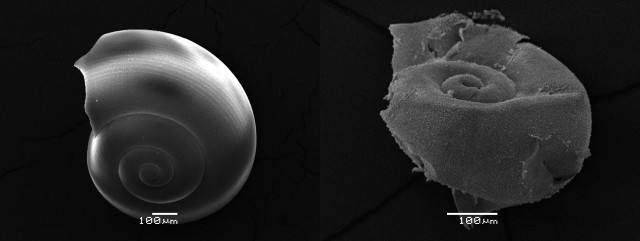
This will be the first in a series of posts about the 6th Mass Extinction debate, and will serve as an introduction to Mass extinctions in general and discuss the past 5 Mass Extinction events (MEEs). As someone with a fair knowledge and definite passion for palaeobiology and the history of life on Earth, I hope that I can share some of my interest with you all in this post! In my opinion, understanding the past can be the key to understanding the present (
Uniformitarianism and all that jazz), but as Geographers we never really consider what Geologists call 'Deep Time' - aka stuff way, way, way before humans were even close to existing. So, if you're new to all this, I hope you enjoy a brief introduction.
-------------------------------------------------------------------------------------------------
Whilst the fact that humans have had dramatic impacts to biodiversity and caused many extinctions (local and global) is relatively undisputable, the question of
whether this is the Anthropogenic 6th Mass extinction event is a contentious topic, as we are to discover. However, this post, as I said, will serve to provide some background information on past MEEs so that we have something to compare a potential 6th Mass Extinction to, in order to make an informed decision.
Officially, there are 5 MEEs that have taken place throughout the 4.5 billion year history of the Earth, as originally identified in the somewhat legendary paper by
Sepkoski and Raup in 1982. Known as the "Big Five" informally,
these events were times when the extinction rate was massively higher than the background levels and a significant percentage of all species go extinct (Usually at least 70%, though some estimates for the Ordovician-Silurian event go as low as 60%). There are many other extinction events, such as the
late Pleistocene Megafauna extinctions, that have taken place in the last 550 million years since the Cambrian explosion (the beginning of complex life), but they do not stand out from background levels significantly enough to be considered 'mass' extinction events. The Big Five, when they were defined, were identified as outliers from a general decline in extinction rates throughout the Phanerozoic (550-0Ma) and this is part of what made them so sensational. However, more recent statistical analysis by
Alroy in 2008 has suggested that they are likely just large peaks within a "relatively smooth continuum of extinction events", but nevertheless, I think they're still pretty cool.
 |
| The Big Five shown as sudden dips in number of genera through time, Source. |
1. Ordovician-Silurian (O-S) or Late Ordovician Mass Extinction
Occuring between 450-440Ma, the O-S event sits at the boundary between the Ordovician and Silurian periods, and is the combination of two events which resulted in the loss of 60-70% of all species which equates to 57% of all genera and 27% of all families. Some scientists rank this as the second largest of the Big Five, in terms of % genera lost.
From what we understand, there were two pulses of extinction with a 4 million year gap between them that culminate in the overall extinction event. The suggested cause for the event is the movement of Gondwana into the southern polar region which led to global cooling and sea level fall,
which caused massive shallow water habitat loss along continental shelves. The very waters in which the first complex life had begun to diversity in 100 million year prior. The Trilobites and primitive Brachiopods (clams et al) were among those animals most heavily affected.
 |
| A typical Ordovician sea, prior to the MEE; Source. |
2. Late Devonian Mass Extinction
The second of the Big Five occurred towards the end of the Devonian period, between 375-360Ma. There is evidence for a prolonged series of extinction pulses causing this event, which wiped out 70% of all species (50% of genera and 19% of families).
There is considerable debate over the timespan of this extinction, with estimates ranging between 500Kyr and 20Myr - the jury is still out of this one. The causes of the extinction event or events are equally open to debate between researchers, but some of the
strongest evidence points towards rapid sea level fluctuations associated with glaciation.
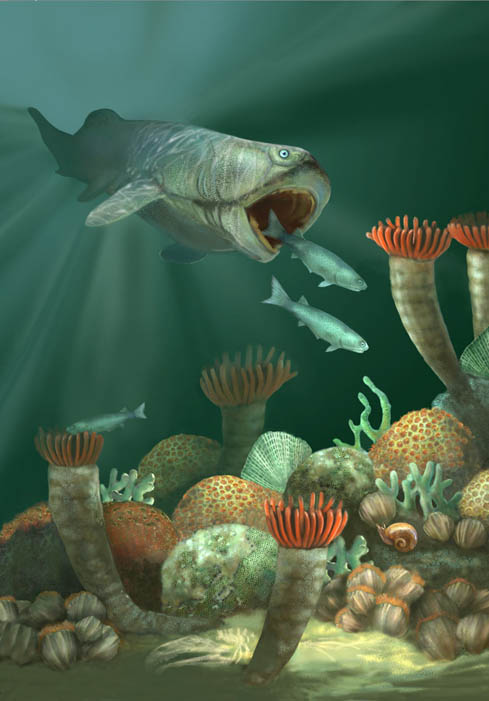
Again, it was marine species that were hardest hit by the event, but the corals disproportionately so, to the point where they were almost entirely wiped out worldwide. The ancestors of the tetrapods (the first vertebrates to reach land) were also impacted, with
44% of high level vertebrate clades becoming extinct, and entire groups such as the Placoderms disappearing (the big fish in the picture below).
 |
| There's always a bigger fish...; Source. |
3. Permian-Triassic (P-T) or End Permian Extinction Event
This one is like the slam dunk of the Big Five, claiming the title of
THE largest mass extinction of all time, ever. A whopping 90-96% of all species were wiped out by this event, that's 83% of genera and 57% of families. This thing is even called the "Great Dying", literally, everyone died. Although this
really sucked for marine animals (RIP Trilobites) and it took the survivors about
10 million years to recover, it left huge vacant niches which allowed the ancestors of Dinosaurs, the archosaurs, to take to the stage and blossom. This event ended the Palaeozoic era and marked the start of the Mesozoic, the Age of Dinosaurs.
The causes are still under a lot of debate, but it is likely that there was a catastrophic event involved, such as huge volcanicity in Siberia.
Another likely factor is the formation of Pangaea, which had huge implications for climate and ocean circulations.
 |
| Trilobites looking pretty, from Haeckel's 'Art Forms in Nature'; Source. |
4. Triassic-Jurassic (T-J) or End Triassic) Extinction Event
One of the smallest of the Big Five, occurred 201.3Ma at the end of the Triassic period, resulting in the loss of 70-75% of all species, 48% of genera and 23% of families. This spelled the end of most non-Dinosaur archosaurs and large amphibians, leaving the way free of terrestrial competition for the Jurassic giants we're all familiar with to radiate.
We have very little idea as to what actually caused this event, though it is likely linked, in my opinion, with the start of the fragmentation of Pangaea. Other suggested explanations include the usual culprits:
meteors and
volcanism.
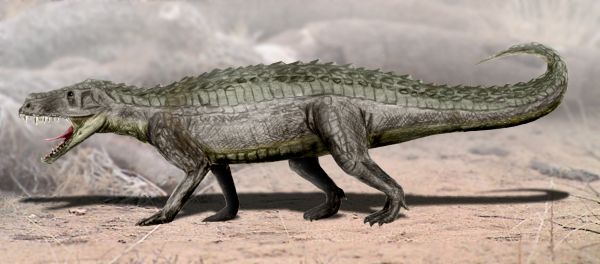 |
| Prestosuchus, a Pseudosuchid ("false crocodiles") lost at the T-J MEE; Source. |
5. The One You've All Been Waiting For
That's right. The End Cretaceous or Cretaceous-Palaeogene (K-Pg) mass extinction event, 65.5 Ma and the infamous end of the Dinosaurs.
75% of all species went extinct (50% of genera and 17% of families), making it relatively small by Permian standards, but yet this is the one we all know and love (or not, depending on how strongly you feel about dinosaurs). All non-avian dinosaurs became extinct as a result of this event, leaving the way for mammals to radiate and become the dominant terrestrial group in the Cenozoic.
Birds are the only dinosaurs that survived this event, whilst other reptiles such as crocodiles and turtles managed to pull through as well. This event, possibly due to a large amount of research bias, is probably the only mass extinction event that we can confidently say the cause of. A massive (10-15km wide) meteor smashed into the Earth in the Gulf of Mexico with the force of 100 teratonnes of TNT or
over a billion times the energy of the atomic bombs at Hiroshima and Nagasaki combined . The impact triggered a variety of catastrophic events across the globe: radiation pulses, acid rain, massive fires, megatsunamis - the list goes on. The amount of evidence for this (
such as the Iridium band) and the causes themselves are really interesting and encourage you to have a look into them further if you have the time! If you prefer the dinosaurs whilst they were alive, BBC's Walking With Dinosaurs never gets old.
So there you have it - the Big Five. We still have a lot to learn about many of these events,
a paper published last month suggested that 3 of them were related to mineral depletion, which is a new one. We may never know the whole story, due to the nature of the fossil record and
the difficulties associated with inferring things from half a billion year old rock. I hope that you've enjoyed this post and that it's been a nice warm up for the 6th Mass Extinction debate. If you have any questions, please feel free to ask in the comments and if you have any interest in materials/documentaries related to the End-Cretaceous event let me know - I have plenty!